The Acolyte's Tale is designed to bring to the attention of fellow Catholics interesting stories, pictures and videos, mostly in relation to liturgical affairs and Catholic music.
It is with profound sadness that we learn of the deaths of Colin Mawby and Stephen Cleobury with just a couple of days of each other.
Requiescat in pace.
Colin Mawby was Master of Music at Westminster Cathedral from 1961 to 1978, and was succeeded in that post for a few years by Stephen Cleobury (before Maestro Cleobury started his tenure at King's College Cambridge, that would last nearly four decades).
Colin Mawby also wrote music for Westminster Cathedral Choir and contributed extensively to the choral music scene in Ireland.
Here are two pieces from the Victoria Requiem, as sung by the great Westminster Cathedral Choir at the Funeral Mass of Cardinal Basil Hume.
[See rolling updates below Update 1: 17 July 2019 Updates 2 & 3: 18 July 2019 Updates 4 to 6: 19 July 2019 Updates 7 & 8: 22 July 2019 Update 9: 28 July 2019]
A.D. 2019 has not been a
happy year for two of the world’s most high profile and important Catholic
liturgical choirs. Both the Westminster Cathedral Choir in London, and the
Sistine Chapel Choir in the Vatican, have been plunged into separate, but
potentially equally grave, crises that could threaten their respective reputations,
and have profoundly damaging repercussions for the cause of high quality Catholic
liturgical music across the world.
Part 1 of this post will
look at the Westminster Cathedral Choir School crisis. Part 2 will look at the
Sistine Chapel Choir crisis.
I cannot stress enough
that, while the Vatican Choir’s situation (as you will see in Part 2) involves
allegations of financial misconduct against choir personnel, the Westminster
Cathedral Choir crisis has NOTHING WHATSOEVER to do with any misconduct by
anyone. Rather, it concerns the decision by the Head Master (Mr Neil
McLaughlan) and the Governors of the Westminster Cathedral Choir School
(chaired by Mr David Heminway), backed to the hilt by Cardinal Vincent Nichols
(who is the President of the School and Director of the Westminster Diocese
Trustee which controls the Charity which runs the Choir School), to abolish Full
Boarding by the choristers for the duration of their tenure (i.e. send them
home on Friday afternoon, and bring them back on Sunday morning).
What appears to be a minor change actually
has profound practical implications, foremost of which (in my mind) is that the
number of services (Mass) at which the Full Choir sings will be drastically cut back, and a close second is that the choristers will have to travel to the Cathedral on Sunday morning for the Principal Mass of the week which will increase fatigue and result in much absenteeism. Each of the other consequences, in
combination, could (and probably will) spell disaster for this great
Choir.
I have blogged before about the Choir's near-death experiences. Then, the illustrious and beloved past Cardinal Archbishops have personally interceded to protect the Choir from harm. It now falls to Cardinal Nichols to do the same, assuming he made his decision without the benefit of honest and unfiltered briefings. If his decision was based on information from the Head Master and Board of Governors that is less than forthright, which, given the profoundly damaging consequences the changes will have, is a reasonable assumption, then the Cardinal can reverse his decision without losing any face whatsoever.
Perhaps the best possible course of action to take immediately is to DEFER the implementation of the new boarding regime until the Cardinal is able to look at the facts afresh (the facts being as I set them out below).
Part 1 – Westminster
Cathedral Choir
Part 1 of this post looks
at the factual background to, and reasoning behind, the decision by the Board
of Governors, Head Master, and Cardinal Vincent Gerard Nichols personally, to
abolish full boarding altogether at the Westminster Cathedral Choir School. Was it made fairly, and with a proper basis? And have the Governors been transparent in communicating the decision to the parents and wider community?
There has been
significant media interest in this story, as per the following (non-exhaustive)
list, and I have drawn heavily on these articles for my facts:
It may be useful to set
out some key dates and events in this crisis:
·Sometime
before March 2019: Unknown persons undertook four months’ “research and
consultation” with unspecified numbers of “chorister parents” and parents of
“non-joiner families” (whoever they may be), and (remarkably) “all the major choir schools in England, including those of the
Oxbridge college” (though these are not named) – this quite extraordinary claim
will become highly relevant as you will see below;
·March
2019: The Board of Governors presented a document entitled “Strengthening the
Chorister Tradition for 2019 and Beyond” (the “Recommendations”) in which a
series of recommendations were made to Cardinal Nichols – I have not seen this
document but would like to – it is critical to this whole affair;**
·Unknown:
Cardinal Vincent Nichols consults with the Archbishop’s Council (members not
identified), the Trustees of the Diocese of Westminster (see graphic below),
the Cathedral’s Chapter (members not identified), the Cathedral’s Administrator
(Canon Christopher Tuckwell) and Master of Music (Mr Martin Baker).It is not clear if the Recommendations were
presented before or after the Cardinal’s own consultations took place, although
the letter dated 28 March referred to below suggests the latter (see the part
where, having mentioned the Recommendations, it states that the Cardinal “in
turn” carried out his own consultations);
·March
2019: Cardinal Nichols “agrees to” the Recommendations in full and without,
apparently, any changes. These are then set out in the letter dated 28 March
referred to below (in other words, it was both something that the Cardinal is
supposed to have made significant inquiries about, but then simply
“rubber-stamped” - i.e. none of his inquiries caused him or his advisers to
give comments back to the Board of Governors to make changes to the
Recommendations);
·28 March
2019: The Chair of Governors, Mr David Heminway, writes to the parents of
choristers (not all parents), copying in the Cardinal and Cathedral Music
Department, notifying of the Changes, which are exactly the same as the
Recommendations made to (and then agreed by) the Cardinal.
[** The oldest trick in the book - Entitle the report that is intended to destroy X something that implies the exact opposite - in this case, you intend to critically Weaken X (the Cathedral Choir), so the Report into the Changes must be called perversely "Strengthening the Choir". Well, that trick may have worked in 1976 when the Choir School Boarding was last re-cast, but it won't work in 2019 I'm afraid]
Here is the full text of
the letter:
Source: Twitter
We are thus being asked
to believe that, having undertaken months of research, and presented the
“fruits” of this to the Cardinal in March 2019, recommending a wholesale change
to the choristers’ boarding programme that had been in place since 1976 (and
then only updated to take account of the new presence of day boys), the
Cardinal then undertook wide consultation of his own, and within the very same
month (March 2019) agreed to the changes so that they could be formally
communicated to all and sundry.If that
is true, then it is an example of the Catholic Church’s bureaucracy acting with
unprecedented alacrity and
efficiency. "Unprecedented” as in “never seen before”.
Why don’t we then explore
the key decision makers involved.
Key Players
The Westminster Cathedral
Choir School is charity, registered with the Charity Commission (No. 1063761).Its annual reportfor 2018 (dated 31 August 2018) sets out the key facts and personnel.For instance, the charity is wholly
controlled by the Westminster Roman Catholic Diocese Trustee. The directors of
this entity – a company limited by guarantee – are the “Trustees of the Diocese of Westminster”
referred to above.Their identities are
listed below, as are those of the school’s Board of Governors.
So, let’s have a look at
just how wide the Cardinal’s consultation was. We are told that the Cardinal (not
his advisers) consulted with:
·the Trustees
of the Diocese of Westminster, of which he is himself a Director (and let’s
face it, the Big Chief Director – indeed he, apparently alone, has power to
appoint, and presumably dismiss, Directors - see graphic above);
·the
Archbishop’s Council: no doubt, Cardinal Nichols is also the head of this
Council, and what are the chances of, say, Canon Christopher Tuckwell also
sitting on this Council? And what about Fr Alexander Master, the Cardinal's Private Secretary? [see update below]
·the
Cathedral’s Chapter: again, the Cardinal must be the head of the Chapter, and
it would likely include Canon Christopher Tuckwell and probably Fr Alexander
Master too [see update below];
·Cathedral’s
Administrator: yes, you guessed it, this is Canon Christopher Tuckwell.
Update: It appears Fr Master is on the Archbishop's Council, while Canon Tuckwell may not be, according to the 2017 Annual Report for the Westminster Diocese Trust. But Canon Tuckwell is certainly on the Chapter of Canons!
We know from the School's Annual
Report that Canon Christopher Tuckwell and Fr Alexander Master sit on the Board
of Governors of the School.So you have
a situation whereby the people who are making the Recommendations for change
(the Governors) are exactly the same people with whom the Cardinal is
apparently consulting in relation to those very changes. I wonder what they could
possibly be telling him?
The only “independent”
person or body with whom the Cardinal is said to have "consulted" is Martin
Baker, the Master of Music (arguably the single most important person with whom
to consult, as, oh, only that person who happens to be in charge of the
choristers for which the school was founded by Cardinal Vaughan in 1902!) And
I’m led to believe the changes were a fait
accompli by then and/or any feedback from the Master of Music was completely ignored
(well it obviously was).
The Cathedral Choir School
Let’s take a further look
at the governance of the Choir School – extracted from the Annual Report for2018:
I’ve not seen the Trust
Deed dated 8 July 1997 (as amended if indeed it has been) by which the School is governed, but would like to. It
is critical in this affair.
What seems key, to me,
are the following facts:
·We can see
the progression of the school from boarding chorister-only, to mixed with day
boys, to (as of 2017) admitting pre-prep boys as well.In other words, the School’s focus has been
moving proportionally away from its foundation status as a Choir School per se, to more broadly being an all-purpose (albeit still
single-sex) preparatory (and now pre-preparatory – sort of Big Nursery) school.
·Nevertheless,
unless there has been an unannounced formal change to the Trust Deed of the
School (the 1997 document), one has to assume that its charter still requires
it to provide choristers “to sing the daily
capitular liturgy in the … Cathedral”.The
(now accepted and implemented) Recommendations contradict this, as choristers
(being home at the weekends) will no longer sing at the Saturday morning
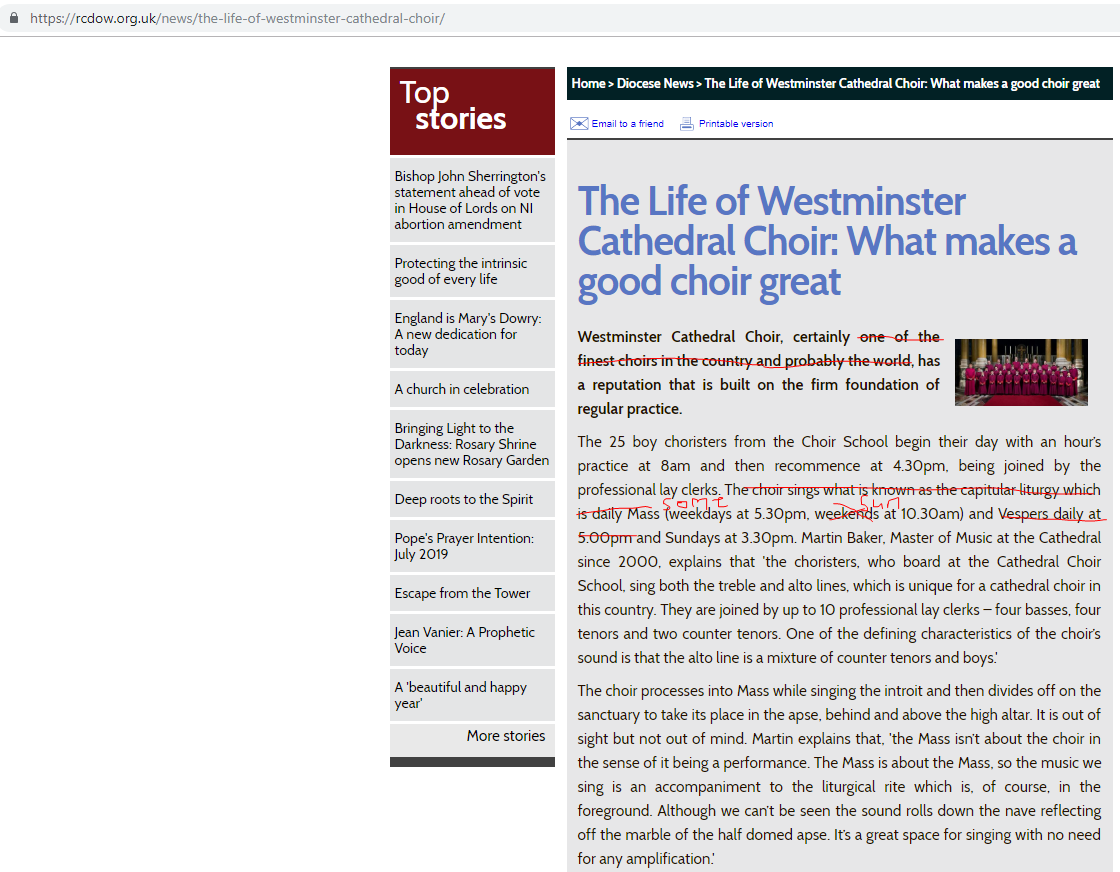
(capitular) Mass, nor at the Friday evening (capitular) Mass.It appears also that the only Vespers at
which the choristers (and hence Full Choir) will sing will be on Sundays (what
a travesty!)
·The School
is “the only Roman Catholic Boarding School” and as such, has a national
catchment area. The practical implications of the abolition of Full Boarding
are that only London-based children will be able to apply as choristers, as so
ably demonstrated by Colin Mawby in his Catholic Herald article.Bye bye to those from the non-Home
Counties.We do not want you
anymore.Sad.
The 28 March 2019 letter – Line by line
Let’s drill down into the
claims made in the letter, shall we? There is some sleight of hand (to say the
least), as you’ll see.For a letter
written by the Chairman of the Board of Governors of a prestigious academic institution,
I will start by saying that the drafting leaves a lot to be desired (or is just part
of the ambiguity for which he, perhaps, was striving).
There are only two express
reasons proffered for the changes:
1. Moving with the times;
2. Pastoral care (more
family time for the choristers).
Neither stands up to even
the slightest scrutiny, as will be demonstrated below.
A third reason is proffered
implicitly:
3. We have consulted all
the top choir schools in the country, and are following suit.
Claim No. 1 – We need to move with the times
So here we are told (without
any citation of a source) that in 1976, about 2,500 boys “boarded at 8+”.We are not told whether that meant Full
Board. This is important.Then we are
told that today, “that number” [remember we don’t really know what “that number”
originally signified] is less than 350 boys “including choir schools”. See what
they did there as well: the implication is that the 2,500 figure might not have
included choir schools, thus making the relative drop appear even greater. But of course it did include
choir schools.
Again, we are also not
told expressly or by reference to any source if the 350 figure is Full Board or
not.What if the 350 figure was Full
Board, and the 2,500 figure was Full Board + all other types of Lesser Board?
Then, the comparison is not a fair one.
Now, I’m willing to give
the Chairman the benefit of the doubt on that one, despite the fact that he
probably doesn’t deserve it. Why? Here’s why, as we come to the next sleight of
hand:
We are told that, variously,
the figures are for boys who “board 8+”, and “24/7 boarding among eight year old boys
has all but disappeared”.In other
words, the author is at pains to say that the figures are for those students
who board (on Full Board) when they are actually
aged eight.It totally ignores the
schools (especially choir schools) whose youngest boys (say, aged eight) start
their first year as probationers on Part Board, before transitioning into Full
Board later on when they are a little older.If the figures cut out a whole lot of such students, then they are highly misleading.I deal more with this below because it is
highly relevant to those “major choir schools” all (in England) of which the Board of Governors supposedly
consulted with. [Spoiler: all the top, top choir schools in England I researched still have 24/7 boarding, but this is phased in over the first year or two of a chorister's tenure. So saying that 24/7 boarding amongst eight year olds may be true, but it is misleading to suggest that therefore it should be abolished not just for the eight year old choristers, but for all choristers of whatever age - which is NOT what the major choir schools in England do in fact - see below.]
The final unsettling part
of this whole particular claim is this: even if Full Boarding has “gone out of fashion”
more broadly, it is probably the case that the 350 boys who still Full Board (even
at the tender age of eight) are likely to be almost all choristers!In other words, maybe there are very good and
important reasons why Full Boarding is especially suited to (and indeed a
requirement for) the majority of choristers who supply a major cathedral’s daily music, even in
2019! This is not a point dealt with by the Chair’s letter, because again, the
source of the figures is not given when it ought to have been.
Was the Cardinal properly briefed about these figures? If not, why not?
I’m going to move, out of
order, to Claim No.3
Claim No. 3: We have consulted all the top choir schools in the country,
and are following suit
It is quite a claim to
make that you have consulted with “all the major choir schools in England, including
those of the Oxbridge colleges.”Now the
author (in his typical ambiguous style), does not define for us what the “major
choir schools” are. But we are given some sense by his inclusion of the choir
schools of the Oxbridge colleges in that phrase.It would also therefore include all the choir
schools of the great Cathedral towns. Canterbury, Winchester, Chichester, Portsmouth,
Wells, Salisbury, Norwich, Ely, Lincoln, Durham, Exeter, Litchfield, Truro and
many, many more, without even mentioning the London based ones.That’s a whole lot of consulting by the Governors
amongst many people who were obviously ready, willing and able to give their
time to be consulted with! Wow, I’m impressed! I’d love to see their expenses
from all those trips to the provinces!
Anyway, I don’t have the
luxury of doing all this “consulting”, so (and I know it’s the poor man’s way),
I simply had to check some facts online.
These are the first (and
only) world-class choir schools I have checked to verify the Governors’ (implied) claims
that Full Boarding was no longer prevalent amongst “all the major choir schools
of England”.Of course, bear in mind we
know that Westminster Cathedral Choir School is the only Catholic school of its kind.So it becomes an especially important institution by that reason
alone. There is no other like it in the World (let alone elsewhere in England).
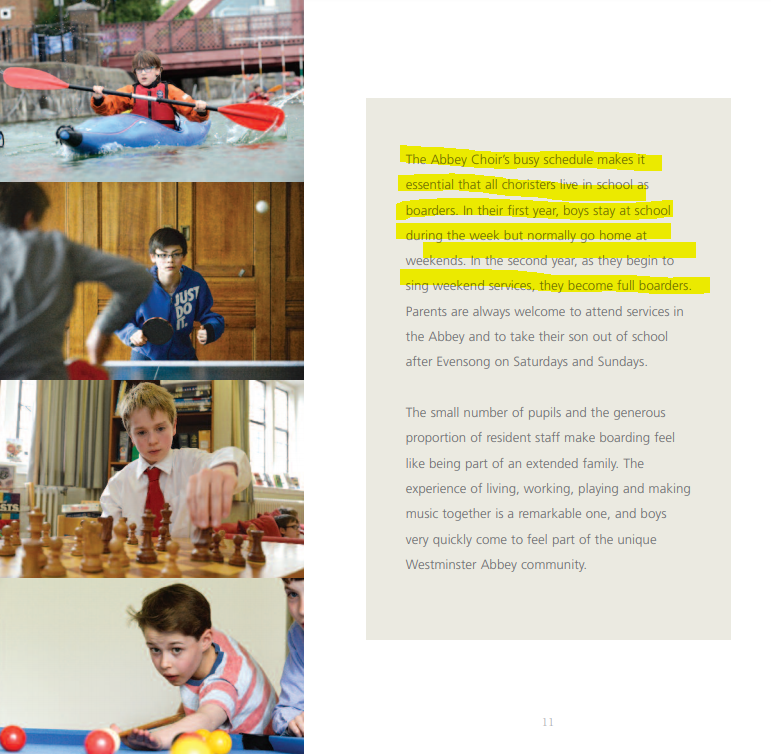
Westminster Abbey Choir School, London
Boarding: 24/7 board after the first year
Arguably the most “major”
of them all, and near neighbours of the Cathedral. Here is their current prospectus
which I generously extract to demonstrate how easily this could all apply to
the (current) Westminster Cathedral Choir - note especially that the Abbey and Cathedral Choirs both have prolific recording programmes with Hyperion (and other famous) labels which is a source of fame and income:
King’s College Cambridge Choir School
Boarding: Two year probationary period transitioning to 24/7 board after that
The other contender for most
“major” of them all.
Christchurch Cathedral, Oxford Boarding: 24/7 after first year, with some Saturdays free too
Both and college chapel and
Cathedral, this is a closer comparison to Westminster Cathedral than, say, some
other Oxbridge colleges, some of which no longer have the boys in on Sunday mornings
in term time.
What about a non-Oxbridge
provincial cathedral?
Ely, Cambridgeshire
Boarding: transition to 24/7 board, with options for weekend visits at the boys’ choice
CONCLUSION: The Chairman’s
letter is an old-fashioned stitch up! Not one of the major-major (sound a bit
Catch-22), or even the minor-major, choir schools that first sprang into my mind seems to have ditched 24/7 boarding.
Unfortunately for the Chairman, some equally old fashioned hard work and research
(aided by the very modern internet) is able to bring this to light. If the Board of Governors was being fully up-front, they would say that they are ignoring what equivalent world-class choir schools are doing (i.e. a transition style boarding arrangement), and instead going straight from Full Board for all the boys of all ages, to Part Board for all the boys of all ages. See - it's pretty simple to be clear and honest if you want to be! Was the Cardinal made aware that the Head Master and Governors were going AGAINST the Boarding regimes at equivalent world-class choir schools? If not, why not? Was the Cardinal even made aware of the nature of the boarding regimes at the nearest equivalent choir schools in England? (i.e. part time boarding transitioning to 24/7 after the first year or two?) If not, why not?
Claim No. 2: It’s for the pastoral care of the chorister
Absolute tosh, I’m
afraid.Read each and every Full Board
programme at the above choir schools and ample – no, generous – provision is
made for pastoral care, leisure time, family visits to the school, and
chorister visits to the family at regular intervals. None have seen fit to shut
down the choir school altogether at weekends, forcing the children to go home
on Friday evenings. This is especially ill conceived in nightmarish London with
the commute involved (believe me, I’m a daily sufferer on the Southeastern
trains from and to Kent every morning and evening peak hours).And then the poor boys are hauled out of bed on Sunday morning to have
to commute back to the Cathedral for the “source and summit” liturgy, instead
of simply traipsing a few yards. I know when I was that age, it was hell for my parents to get me and my two sisters to Mass on time and in good spirits!
And if you want further proof
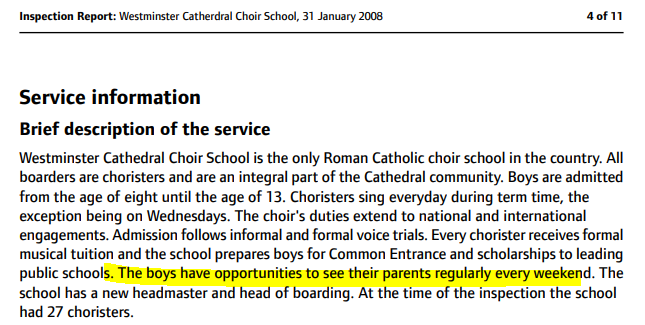
that claim is utter nonsense, consult these two reports: an OFSTED report from 2008 and a much more recent (Nov 2018) report from the Independent Schools Inspectorate.The OFSTED report from over a decade ago highlighted
a problem with bullying, but found that “Most parents
are exceptionally happy with the care and education their sons receive.” Improvements
were being made at that time in terms of greater provision of leisure
activities, but there was no suggestion that family time was too restricted or
that either the boys or the parents wanted (or needed) this to be increased.
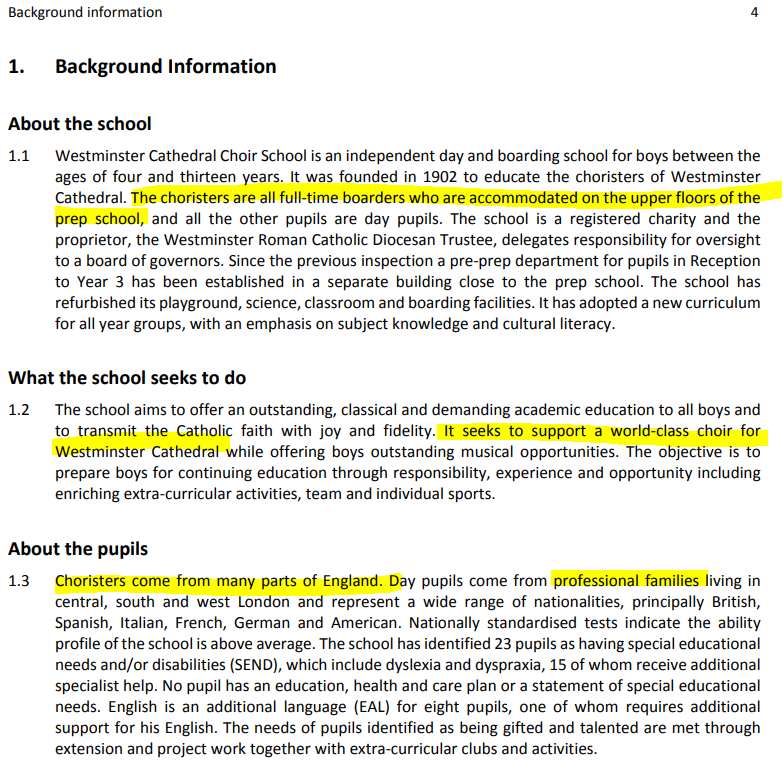
And a bombshell: in the November 2018 ISI
Report, we read that:
So the Westminster
Cathedral Choir School already consulted regarding other similar choir schools,
made and then implemented pastoral changes aimed at boarder well-being shortly before
November 2018!! The ISI’s Report is a glowing endorsement of the Choir School
and boarding arrangements - the School rightly boasts about it (see below).Why on earth
was there then (immediately) a 4-month long further review from December 2018
to March 2019 which then made recommendations wholly inconsistent with the boarding programmes
at other similar world class choir schools??
OFSTED REPORT (2008)
ISI Report (2018)
The Westminster Choir School advertises its excellent score in the 2018 Inspection report
So the claim that the change to the boarding arrangements was necessary due to pastoral considerations has been comprehensively debunked.
Was the Cardinal made aware of the November 2018 ISI Report? If not, why not? Was the Cardinal aware that the Choir School had already (shortly prior to the 2018 ISI Report) consulted other equivalent choir schools and implemented changes that resulted in the glowing November 2018 ISI Report? If not, why not?
Conclusions
I shall not speculate, as some others have, that the real reason for the changes is (eventually) to pave the way for the abolition of boarding altogether. Or perhaps financial considerations (if these two issues are not inherently linked anyway).
All we can say for sure is that NONE of the reasons proffered by the Head Master, Board of Governors (and ultimately accepted by the Cardinal) withstand scrutiny. So there MUST be other reasons for the changes. In the absence of transparent disclosure from the School and Cathedral authorities, chorister parents (many of whom are against the changes), the Cathedral Music Department (who are completely against the changes), parishioners of the Cathedral and the wider Catholic community in England & Wales and beyond are entitled to draw negative inferences. Implications
The choir will now rehearse less.
It will also sing at daily Mass a lot less. That means the average punter in the pew has less chance to hear the choir, and the choir less chance to practice its art "for real". We will all be diminished by this, as Colin Mawby put it so well.
Perhaps most damaging of all, as I allude to above (and as is also so ably demonstrated by Colin Mawby), the boys will have to be transported by their families to Sunday Morning Mass at the Cathedral. This will invariably result in lateness, non-attendance and lethargy amongst the choristers (less sleep to account for travel time). Now I know how important this is. I live in greater London (Borough of Bromley). It takes 50 mins for me to drive to the Cathedral on a good Sunday, and that's without road works (i.e. never). It takes 20 mins on the train, which are so often not running on Sundays due to engineering works (or are late / cancelled / diverted) if they are running. It's a lottery if I can even get to the Cathedral on time or at all. If the trains are not running, I basically do not go to Westminster Cathedral for Mass, too long and arduous the drive into central London is. What about for the chorister parents on a weekly basis? Or is the Cardinal expecting them all to commute from as close as Kensington with a police escort?
Down to the facts:
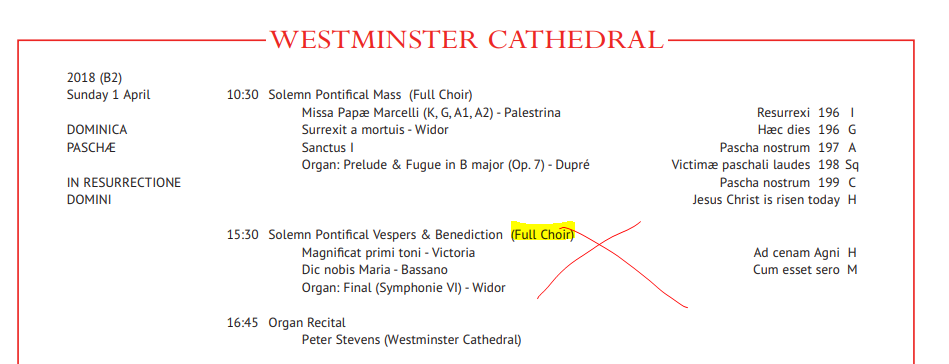
I demonstrate graphically below the services we will lose the choristers from in any given week, and the two lots of Vespers (on Christmas Day and Easter Day) that we will also lose (travesty!)
Now, I will leave it to the experts to opine on whether these cut-backs will affect the quality of the choir's singing. However, what they say is this:
And what of the professional men? If there is even a perception (yes perceptions are important too) that the quality of the choir will be diminished, then the professional men who offer their services will likely think twice about whether they want to be associated with the choir’s output. These are men who sing in the top London and International choirs. They have professional reputations to consider. Lose the best of these, and the choir’s path to demise will be a very short one indeed. Key Further Documents
If any legal action is
being considered in relation to this decision, then I would recommend, as a
bare minimum, getting genuine copies of the Recommendations dated March 2019 (which will show how the Changes were framed to the Cardinal), the Trust Deed dated 8 July 1997 in accordance with which the School is governed (which is necessary to show whether the Changes are lawful),
and whatever document was penned by the Cardinal (presumably drafted by an aide and not the Cardinal personally) in
which he stated that:
From the context, it
appears to be the letter / email by which he communicated his agreement to the Governors’
Recommendations.By quoting from this
document in the letter to parents, it is fair game for the whole of that document
to be published (and indeed transparency requires it) and I call upon the Cardinal’s
Office and the Board of Governors to do so without delay, along with the other documents listed above. Key Clarifications from the Head Master, Board of Governors, and the Cardinal I have set out above in the documents that the Board of Governors must release publicly in the interests of full transparency. I have also set out in red text the questions that the Head Master, Board of Governors, and the Cardinal, must answer to address the serious issues raised on the face of the 29 March 2019 letter to chorister parents. I set them out again below. Now, if the Cardinal was aware of the full background to the recommended Changes (i.e. that they were not actually based on or supported by the reasons cited in the letter) AND still approved the recommendations, then that is that. But if I were the Cardinal, and I became aware that I may have been hoodwinked (or had crucial details of the background withheld from me), and made a public decision erroneously as a result, then I would feel profoundly embarrassed and want to put the brakes on the Recommendations being implemented until further investigations are carried out. There would be no shame in that, and indeed it would be essential to do so. So, here again are the most critical questions arising from the letter to chorister parents: What does the 1997 Trust Deed require the Choir School (a Charity regulated by the Charities Commission) to actually do in terms of proving choristers for the Cathedral? What is the full text of the Recommendations made to the Cardinal in March 2019? Was the Cardinal properly briefed about the unsourced statistics about boys' boarding in 1976 vs 2019? If not, why not? Was the Cardinal made aware that the Head Master and Governors were going AGAINST the Boarding regimes at equivalent world-class choir schools? If not, why not? Was the Cardinal even made aware of the nature of the boarding regimes at the nearest equivalent choir schools in England? (i.e. part time boarding transitioning to 24/7 after the first year or two?) If not, why not? Was part time transitioning into full board offered as an option for the School in the Recommendation (or in any briefing note associated with the Recommendation, since the Recommendations themselves seem to have simply been as outlined in the letter)? Was the Cardinal made aware of the November 2018 ISI Report? If not, why not? Was the Cardinal aware that the Choir School had already (shortly prior to the 2018 ISI Report) consulted other equivalent choir schools and implemented changes that resulted in the glowing November 2018 ISI Report? If not, why not? Who drafted the correspondence by which the Cardinal agreed to the Recommendations of the Head Master and Board of Governors? UPDATE 1 I emailed the Cardinal, Head Master and Chair of the Board of Governors yesterday afternoon. I linked to my blog and set out a series of questions as per Table 1 Below. I have received a response (and "Account of the current situation" dated 17 July whose authorship and date of drafting is unknown) from the Cardinal's PA Ms Ellen Dunleavy, for which I am grateful. No response from the Head Master or Chair of the Board of Governors. The Account is clearly a "stock" response sent to anyone who writes to the Cardinal on this issue. I have replied a short time ago with two rounds of further questions, which I set out as Table 2 and Table 3 below. I will publish any clarifications that are provided, in the interests of uttermost fair dealing and transparency. The Account
Table 1
Query
Cardinal’s Comment
Head Master’s Comment
Board of Governor’s Comment
What does the 1997 Trust Deed require the Choir School (a Charity regulated by the Charities Commission) to actually do in terms of providing choristers for the Cathedral? Please provide the whole document for review.
What is the full text of the Recommendations made to the Cardinal in March 2019?
Was the Cardinal properly briefed about the unsourced statistics about boys' boarding in 1976 vs 2019? If not, why not?
Was the Cardinal made aware that the Head Master and Governors, in making their Recommendations, were going AGAINST the Boarding regimes in place at equivalent world-class choir schools in England? If not, why not?
Was the Cardinal even made aware of the nature of the boarding regimes at the nearest equivalent choir schools in England? (i.e. part time boarding transitioning to 24/7 after the first year or two?) If not, why not?
Was part time transitioning into full board offered as an option for the Choir School in the Recommendation (or in any briefing note associated with the Recommendation, since the Recommendations themselves seem to have simply been as outlined in the letter)?
Was the Cardinal made aware of the November 2018 Independent Schools Inspectorate Report which gave a glowing assessment of the choristers’ well-being? If not, why not?
Was the Cardinal aware that the Choir School had already (shortly prior to the Nov 2018 Independent Schools Inspectorate Report) consulted other equivalent choir schools and implemented changes that resulted in the glowing November 2018 ISI Report? If not, why not?
Who drafted the correspondence by which the Cardinal agreed to the Recommendations of the Head Master and Board of Governors, which is quoted in the 28 March 2019 letter to chorister parents?
Table 2
Question
Cardinal’s
response
Head
Master’s response
Chairman
of the BoG’s response
Preliminary
questions regarding your email response
Has the Cardinal personally read the
content of my email dated 16 July?
Has the Cardinal personally read the blog
post for which a link was provided in that email?
Did the Cardinal personally ask you to send
your response to that email?
Has Fr Alexander Master, the Cardinal’s
Private Secretary, personally read the content of email dated 16 July?
Has Fr Alexander Master personally read
the blog post for which a link was provided in that email?
Did Fr Alexander Master personally ask you
to send your response to that email?
Preliminary
questions that arise from the Account
·The Account is dated 17 July
2019. Was the Account drafted on this date, wholly or substantially?
·If not, when was it wholly or
substantially drafted?
·Who drafted this document?
·Was it the Cardinal personally?
·Fr Alexander Master
personally?
·The Head Master personally?
·The Chairman of the Board of
Governor’s personally?
·By someone instructed by any
of these people (if so, please specify by whom it was instructed)?
The Account is unsigned.
·Who settled this document?
·Was it the Cardinal personally?
·Fr Alexander Master
personally?
·The head Master personally?
·The Chairman of the Board of
Governor’s personally?
·By someone instructed by any
of these people (if so, please specify by whom it was instructed to be
settled)?
·Was it settled in writing or
verbally?
Has the Cardinal personally seen the text
of the Account dated 17 July 2019?
The issue of chorister recruitment per se was not given as a reason for
the boarding changes change in Mr Heminway’s letter to chorister parents dated
28 March.
Why is this?
This is especially important given that in
the Account it is now offered as the sole
or only reason for the Cardinal
agreeing to the changes.
·Was the reason chorister recruitment
was cited as the reason for the change only due to the fact that it became
clear that the original reasons published (in the letter dated 28 March) did
not stand up to scrutiny?
·If not, when did issue if
chorister recruitment become the sole reason of the changes?
·Where is this recorded?
The premise of the Account is that the
Cardinal has based his decision solely on the recruitment issue.
Please (according to my earlier request)
provide the full, unedited text of the document "Strengthening
the Chorister Tradition for 2019 and Beyond” in the same form it was sent to
the Cardinal, and the Cardinal’s response thereto (quoted in the 28 March
letter) confirming his decision to agree to the Recommendations, and any
other form of briefing note brought into existence in the lead up to the Recommendations
being sent to the Cardinal.
This is necessary to confirm that
chorister recruitment was one of the issues proffered to the Cardinal as the
basis for the Recommended changes.
The Account states that chorister
recruitment had been an issue for the last 5 years. What steps did the Choir
School (Head Master, Board of Governors, and anyone else connected thereto) take
to address this before it
apparently became so dire as to (in the Choir School’s view) require the changes
now being implemented?
Who is responsible for chorister recruitment?
Who runs the recruitment campaigns?
Please provide all details of recruitment
campaigns, including the figures for number of choristers applying for voice
trials, year on year for the last 10 years.
It is common practice for organisations
such as schools and businesses to have 5 to 10 year plans for the organisation,
its growth, and future direction. If
the abolition of boarding at the Choir School altogether were to have been
planned, it would be part of such a 5 to 10 year plan.
·Is the abolition of boarding altogether
at the Choir School planned?
·Has its complete abolition
ever been discussed, minuted, or formally or informally agreed to in the last
10 years?
·Is it part of a long term
plan for the Choir School?
·Have the Choir School, the
Trustees of the Diocese of Westminster, or any party connected therewith, lodged
any documents with the Council of the City of Westminster (or any other
relevant Body) in relation to the planned alteration, or change in use, of
the boarders’ accommodation or the possibility of doing so in the future?
·If not, has any of these
entities engaged or spoken to professionals, or spoken or discussed
internally, about the possibility of changing the use of the boarders’ accommodation
in the future?
If the complete abolition of boarding is
not currently on the cards, or part of any plan for the short, medium of long
term future of the Choir School, would the Cardinal be willing to confirm
this, by writing and signing a note to this effect?
Other questions are set out in a marked up
version of the Account.
Table 3
Text of
Account
Comments
Questions
The challenge that has had to be addressed in recent months was
that in the last five years the number of families approaching the school for
voice trials for their sons had more than halved.
Halved from what to what?
See below questions re recruitment practices in the “last five
years”.
Admissions of choristers had reached a level that, if not
addressed, risked the future of the choir.
The implication is that the numbers had fallen to this point
BECAUSE OF the full boarding situation. Please provide evidence for
this.
See below questions re recruitment practices.
Since the announcement of the changes in boarding, the number of
families seeking admission for their sons has doubled.
How many were seeking admission before the changes?
How many after? How many of these did so AS A RESULT OF THE
changes to boarding? Since this is the implication of the statement, how can
you demonstrate this to be true?
Furthermore, there are already a good number of families
approaching the school for admission to the choir in September 2020.
How many? What evidence is there these people have approached
the school AS A RESULT OF the change in boarding as you imply they have by
making this statement?
In February this year, when the process of consultation was
being concluded, there was one new chorister for admission to the choir in
September 2019.
When did the Sept 2019 recruitment campaign begin and end?
According to the Tablet, the Cardinal said:
“For
2019/20 we have just one probationer confirmed, with two offers out. There
are no further enquiries, despite an expensive national marketing campaign, a
meticulously-run open morning, and a £10,000 promotional video.”
Give details of the “expensive national marketing campaign”.
Give details of the “meticulously-run open morning”. How does
the Cardinal know that it was meticulously-run”? Did he attend?
How were families invited to attend the chorister open day? How many
attended?
Please provide a copy of the “£10,000 promotional video”
Who is responsible for recruitment of chorister-pupils?
Who is currently responsible for recruitment campaigns for
chorister pupils? If different, who has been responsible for the recruitment
campaigns for each of the last 5 years?
Detail each of the recruitment campaigns for the 5 years before
the unsuccessful 2019 campaign?
Please comment on the assertion in the Tablet that the
recruitment campaign was not at all well run:
“As for the
recruitment issue, some question whether over the last few years there has
really been a concerted, upbeat effort to spread the news of the wonderful
full-time chorister experience to the country’s 2,134 Catholic primary
schools in Britain. At the annual “meticulously-run open morning” referred to
by Cardinal Nichols, no chorister parents are invited along to allay the
fears of prospective parents who might be nervous about full-boarding for
their sons. The school only needs to find five new probationers each year
from the vast national pool; and if the full-boarding experience were
properly respected and treasured by the headmaster, many of the current
chorister parents feel sure he would have little trouble recruiting.”
And see below questions.
Now, seven new choristers will be joining in September: this is
unprecedented.
I appreciate that seven choristers joining in September 2019
must be unprecedented, as that date hasn’t come around yet. Please explain
how this is otherwise “unprecedented”. Please provide all necessary data to
support this statement (e.g. records chorister admissions dating back to 1902
or at least as far back as 1976).
When were these “seven new choristers” first approached, or when
did they first approach the school showing interest in joining the choir?
Were any of these 7 choristers ones who turned down places
previously (or were among those whose parents who had previously considered
sending their sons to the school)? If so, what were the specific reasons they
turned down places initially?
The importance of this is, if the 7 were entirely or
substantially new:
- there is no way of saying whether they would or would not have
joined under the old boarding regime. They simply said yes to the new one
without being offered full board;
- it means that there were other more important reasons that the
other boys who considered attending earlier but decided not to, did so for
other reasons, not the boarding (likely to be that they received an offer at
what their parents considered to be a better school)
The process of consultation involved both parents of current
choristers and those who had considered sending their sons to the school.
The newspaper articles in relation to this issue state that many
chorister parents feel that they were NOT properly consulted. E.g. a parent writing in the Tablet:
“No proper or open consultation process
took place. In January the chorister parents were sent a short,
innocuous-seeming, box-ticking survey, asking how satisfied they were with
their sons’ experience as choristers. Most could not have had any idea of the
cataclysmic changes the school had up its sleeve.
When a dark rumour started to circulate, the
headmaster reassured them in an email that it was mere “Chinese whispers”.
The choristers were formally informed by the staff of the changes only 20
minutes after the email had been sent out, before they’d had a chance to chat
to their parents. The three Siemens brothers from Wales had the instant
feeling that they would have to leave, which has indeed proved to be the
case.”
How many chorister parents were there during the consultation
period?
How many of these were consulted?
How else were the current chorister parents consulted, other
than by this “short, innocuous-seeming, box-ticking
survey, asking how satisfied they were with their sons’ experience as
choristers”?
How then were those “who
had considered sending their sons to the school” consulted? How many of these
were there? How many of them were consulted? What questions were they asked?
What responses were given?
How many of the “seven new choristers” are among the children of
these parents who were consulted in Feb 2019 as parents “who had considered
sending their sons to the school”?
The present pattern of boarding emerged as a significant factor
in their views and decisions.
How many of those chorister
parents that were consulted gave feedback that “the pattern of boarding” was
“a significant factor in their views”?
How many of the parents “who had considered sending their sons
to the school” that were actually consulted gave feedback that “the pattern
of boarding” was “a significant factor in their views and decisions?”
What does “significant factor” mean? What other factors did
these parent give as a basis for their “views and decisions”? Did any of the
parents who had considered sending their sons to the school but didn’t
actually receive offers? If they did, what were the specific reasons for
turning them down? Was he dominant reason the “pattern of boarding”? Which
schools did they end up sending their sons to? Were these other schools even
choir schools?
Is it correct that the new pattern of boarding forced 3 Welsh
choristers to be withdrawn from the Choir?
The consultation subsequently included the Cathedral Chapter and
the Trustees of the Diocese.
The Cardinal is the main Trustee of the Diocese. Which other trustees
were consulted? How? What were their responses?
Canon Christopher Tuckwell (the Administrator of the Cathedral) sits
on the Cathedral Chapter. We know the cardinal consulted him personally. But
who did the Head Master and Governors consult among the 18 or so Canons of the
Chapter other than Canon Tuckewell? What
were their responses?
The Cathedral Administrator and Master of Music were personally
consulted by the Cardinal.
I take it that, by stating separately that Cardinal personally
consulted the Cathedral Administrator and Master of Music, that these were
the only ones he personally consulted with.
Please confirm?
What did the Master of Music advise the Cardinal during the consultation?
Care is being taken that musical standards are protected. The
choristers currently rehearse on six days of the week; from September they
will also rehearse on six days of the week.
-
What is the “current” actual number of rehearsal hours?
What will that be from September?
If different (i.e. fewer hours of rehearsals from September),
why does the Account not simply state this upfront, to avoid inevitable
accusations of obfuscation and deception?
What about singing lessons? Will the actual number of hours of
singing lesson be the same, or will there be a drop?
What about hours of performance singing at services? How many
hours are lost due to the new boarding arrangement?
Please let me know if the assumptions below are incorrect:
- Two hours fewer for rehearsals
- Two hours fewer for singing lessons
- Two hours fewer for performance signing (for the Fri and Sat
masses no longer attended)
- Six hours fewer hours singing overall per week
- Assuming 40 weeks in the choristers’ term time, that’s at
least 240 fewer hours per year singing.
In addition, the Sunday Morning rehearsal and Mass will follow
immediately after the choristers’ are brought back from their respective
homes. Can you guarantee they will be
as rested and well-prepared as if they were on site?
In those circumstances, please explain what “Care is being taken
that musical standards are protected”?
What has the Cathedral Music Department advised in this regard?
If they have advised that musical standards are likely to drop, on what basis
has the Cardinal, Head Master, and Board of Governors satisfied themselves
that musical standards will nevertheless be maintained?
Have the professional adult Lay Clerks of the Cathedral Choir
advised the Cardinal as to their view on whether musical standards will drop
following the changes? If they have advised that musical standards are likely
to drop, on what basis has the Cardinal, Head Master, and Board of Governors
satisfied themselves that musical standards will be nevertheless be
maintained?
The question of finance has never been part of these
considerations. No potential chorister has ever been turned away for lack of
finance. No contribution to the Chorister Hardship Fund has been declined.
Indeed, further contributions are welcome.
I do not see the relevance of this paragraph to any questions
I’ve raised in emails to the Cardinal or on my blog. I suspect this gives
credence to my suspicion that this is a “stock” response, and must have been
drafted much earlier than the 17 July 2019 date that it bears.
No questions.
Perhaps it is not surprising that families wish to be able to
spend more time with their sons while also being enthusiastic in wanting them
to enjoy the experience and commitment of being choristers in Westminster
Cathedral Choir.
Not sure of the relevance of this statement.
The fact is, full time boarding has been in place at Westminster
Cathedral since 1902. It continued in place following the admission of day
boys in 1976. It is the reason for the
world class standard of the choir. The
onus is on the people changing this regime to justify how this world class
standard will be maintained, where almost every other near-equivalent world
class choir school in England considers in necessary to maintain full-board
to uphold the highest standards. I
demonstrate this on my blog and will not repeat here.
The use of emotional sleight of hand (as this statement betrays)
is unbecoming of the Cardinal (if he actually drafted this sentence) or
whoever did draft this sentence. It is emotionally manipulative because it
implies that those who want full-boarding to remain somehow do not place
importance on the choristers spending as much time as possible with the
parents. This is a suggestion wholly unworthy of a Prince of the Church. And the implication is completely untrue. Once again, if the author of the Account had
bothered to read my blog, they would have seen that the recent ISI Report is
glowing in terms of the choristers’ personal well-being and development, and
ample family time is already catered for during the week and at
weekends.
No questions.
17 July 2019
-
As per other question: when was this document actually drafted?
Update 2 I summarise where we are up to in this affair:
Date
Key document / issue
Relevance
Source (where
applicable)
Comments
Late 2018 to February
2019
Details of the
consultation period
This will be critical
to understanding who the Head Master etc consulted with, and what their
feedback was.
It is especially
important in order understand the reason (now given in the Account) as to why
recruitment of choristers had floundered in 2018-19.
Does the feedback
actually support the proposition, advanced in the Account, and in the
Cardinal’s email agreeing to the boarding changes (see extracts in the Tablet
article) that the boarding issue was the CAUSE of the recruitment problems?
This is fundamental
because the boarding changes are being justified SOLELY by reference to the
recruitment issue (which, yes, is inconsistent with the Chairman’s latter of
28 March which did not expressly refer to recruitment problems at all).
That document relied on seriously questionable statistics as to boarding
overall. See more below.
“Strengthening the
Choir” document (assumed)
Requested from the Head
Master, Board of Governors, and Cardinal.
Not yet received.
If the feedback is set
out in any detail, this will enable us to understand the reasons why
prospective choristers did not end up attending the WCCS.
In particular, it will
enable a proper understanding of whether there were in fact other compelling
reasons for the boys not attending other than the boarding arrangement,
primary among these would be:
- They were not offered
a place by the school (either due to not meeting the musical standards
required, or , meeting musical standards, the school otherwise did not offer
a place);
- It may even allow us
to understand whether the "parents who had considered
sending their sons" who were consulted were parents who had recently
shown interest, or whether some of these parents were from previous
recruitment years (i.e. were the numbers stacked). This would be manifestly
unfair if the school went into the past to find parents who did not send
their sons to WCCS for comment, but did not do the same for past parents of
choristers. This is particularly egregious if these parents' comments are
then being used to support a recruitment problem that has occurred only very
recently.
March 2019
“Strengthening the
Choir”
The most critical
document of all. I assume that this document contains all the
background information which the Head Master used to support his
Recommendations to the Cardinal. It may have the raw data set out – in
which case, excellent. It will almost certainly also contain the
information to back-up the claims made in the Chairman’s letter (or, on the
other hand. show them to be highly suspect).
I am particularly keen
to see if this document sets out:
- the other choir
schools actually consulted (it would make it a long document!)
- the statistics re 8+
boarding, to give the full context, and to see if my hunch is right that as
soon as the boys get older, that figure of 340-odd shoots right up
- the figures that will
support the claim in the Account that in the last 5 years, applications for
voice talks have halved. Of course, we need the year on year figures. Because
it will be highly misleading if they were, say:
50 in 2014
70 in 2015
30 in 2016
55 in 2017
45 in 2018
25 in 2019.
You see - they have
"halved" in the last 5 years (sort of - rather, the 2019 figure is
half of what it was in 2014 0- that's a bit different), but it give a
misleading impression!!! It also means that only in the last year have they
REALLY dropped.
My goodness me, there
will be much to pull apart if only I were to be provided with that
document!
Requested from the Head
Master, Board of Governors, and Cardinal.
Not yet received.
I have a sneaking
suspicion that, if the Chairman of the Board of Governor’s letter was a
“stich-up” (which I’ve already demonstrated is highly likely), then the
“Strengthening the Choir” document is likely also to be a “stitch-up”.
Of course, if that document is a fair document, then the Head Master et al
will have no issue with it being released publicly, at the
earliest opportunity, to allow proper scrutiny of it.
It will, I assume,
allow us all to ascertain whether the Chairman’s extraordinary claim that “all the
top choir schools in England, including those of
the Oxbridge colleges” were indeed consulted is in fact true, or
if true, accurately records the manner in which this is set out in the
briefing to the Cardinal.
March 2019
Full text of email from
Cardinal advising of decision
Shows the basis upon
which Cardinal himself made his decision.
The Tablet (partially
extract only)
Requested from the Head
Master, Board of Governors, and Cardinal.
Not yet received.
We need to know who
actually drafted that email too, and who settled it. Was it the Cardinal
personally, or his Personal Secretary?
17 July 2019
Account of the Current
Situation
Sets out the basis of
the Changes
Emailed to me by the
Cardinal Personal Assistant
Series of questions
sent to Cardinal et al for comment on this document.
Authorship and date of drafting
unknown.
Raises serious
questions as to the fidelity of the basis of the basis of the decision to implement
the recommended changes.
Assumed that heavily
reliant on the Strengthening the Choir document – so if it falls, so does
this Account.
28 March 2019
The Chairman’s letter
to chorister parents
Gives reasons, and
statistics, in support of the Changes (despite not including the very reason
now relied on in the Account).
Twitter
Various statistics
cited in the letter need a source (e.g. the figures regarding 8+ boarding) –
so that they can be seen in their full context.
1997
Trust Deed and
Instrument of Government
Legal framework of the
WCCS charity, it charitable purposes, etc
Requested from the Head
Master, Board of Governors, and Cardinal.
Not yet received.
Possibility of
obtaining this from the archives of Westminster City Council
Now, if on review of these further documents (which
I’ve not been provided with by the Head Master, Chairman or Cardinal), it is
found that they are seriously flawed, or even manifestly misleading, and/or
they reveal the Chairman of the Board of Governor’s letter of 28 March 2019 to
be seriously flawed, or even manifestly misleading (as I suspect with a good
basis, it might be), then if I were the other
Governors on the Board of Governors (Mrs Julie Buclez, Mrs Maria Church, Mrs Kate Finch,
Martin Hattrell, Dr Marco Liviero, Mrs Marta Luiz (Finance Director of the
Diocese), Mrs Flora Lyon, Rev Alexander Master, Mr Mike Pittendreigh (Assistant
Director of Education for the Diocese), Rev Stuart Seaton Canon Christopher
Tuckwell (Administrator of the Cathedral), Mr Stephen Withnell), I would be feeling mightily uncomfortable
about this whole affair.
As a Governor, I would be especially perturbed if,
knowing the content of the “Strengthening the Choir” document, the Chairman (Mr
David Heminway) sent his letter out in our, the other Governors’, name, drafted
in the manner it was. Indeed, I would
want to disown it, publicly.
Indeed, I
may be under a legal duty that would COMPEL me to set the record straight. And if the "Strengthening the Choir" document
is itself is seriously flawed, I certainly would not want ANYTHING to do with that
document, as it may have ACTIVELY misled the Cardinal Archbishop of Westminster,
chorister parents, the Cathedral Music Department, parishioners of the
Cathedral, and now even the wider public.
“Governing bodies are corporate bodies and,
because of this, individual governors are generally protected from personal
liability as a result of the governing body’s decisions and actions. Provided
they act honestly, reasonably and in good faith, any liability will fall on the
governing body even if it has exceeded its powers, rather than on individual
members.
Individual governors have no power or right to
act on behalf of the governing body, except where the whole governing body has
delegated a specific function to that individual, or where regulations specify
that a function is to be exercised in a particular way. The governing body is
legally liable for all actions taken in its name by individuals or committees
to which it has delegated functions. The governing body should therefore ensure
that decisions to delegate specific responsibilities are properly minuted and
recorded.”
This raises two obvious questions (among many
others):
1. Was the Strengthening the Choir document settled,
and circulated to the Cardinal and others, by the Board of Governors
collectively? Or was it on the say so of the Chairman alone?
2. Was the Chairman’s the letter to parents
dated 28 March 2019 settled and circulated by the Board of Governors
collectively? Or was it sent by the Chairman acting alone?
Again, I call upon the Head Master, Chairman
of the Board of Governors, and the Cardinal’s office, to release the "Strengthening
the Choir" document without delay.
Another document which it is now essential to
be disclosed is the “instrument of government” (which will probably also have appended
to it the crucial 1997 Trust Deed).
“The instrument of government is the document
that records the name of the school and the constitution of its governing body.
The governing body drafts the instrument and submits it to the LA. The LA must
check if the draft instrument complies with the statutory requirements,
including the relevant guiding principles for the constitution of governing
bodies. If the instrument complies with the legal requirements, the LA will
make the instrument. The governing body and LA can review and change the
instrument at any time. Before the governing body submits the draft instrument
to the LA, it has to be approved by the foundation governors and, where
relevant, any trustees and/or the appropriate religious body.” (same ref as above)
All of this will be relevant to any legal proceedings
that are brought seeking to impugn the legality of the Cardinal’s decision, and
all the intermediate decisions taken by the Board of Governors (or individual governors
without the Board’s approval, as the case may be).
Update 3
While conducting further research online, I have managed to unearth what I THINK might be the document that supplies the figure for "8+" boarding referred to in the Chairman's letter of 28 March 2019: a document found on the website of the Independent School's Council.
Now they seem to publish census data for
independent schools. The latest census is for 2019. However you can download
previous years too:
Now I couldn't see the Chairman's figures in the 2019 census. But go to the 2018 census, which can be downloaded here: https://www.isc.co.uk/media/4890/isc_census_2018_report.pdf
Here we see the Chairman's figure of 342 for "8+" boarders.
However, AS I SUSPECTED, the numbers rise
drastically the older the boys get. In other words, it is highly misleading to
have expressed the letter in the manner the Chairman did, without citing the
source or context of the figure of 342. We know, AS A FACT, now that actually
large numbers of boys still full board, but the fashion seems to be to ease or
transition into this arrangement. I
cannot see in this census report the "around 2,500" figure cited by
the Chairman as the figure for 8+ boarders in 1976. The source of that
statistic still eludes me.
O dear, can you remind me what a Governor's
duty is?
Update 4
Having mulled over this some more last night,
what I would also like to know more about is:
1. the process by which the Governors were
briefed about the Changes;
2. the attendance at governing body and
committee meetings over the last academic year. This information ought to be
published, and if not published, then provided when requested [see below]. I
now request this information to be provided by the Board of Governors as soon
as reasonably practicable.
3. the structure and remit of the governing
body and any committees, and the full names of the chair of each.
Why is this important?
1. This is important because we need to know
what role the Governors had in making the Recommended changes to the Cardinal.
The assumption so far has been that, exercising their role as the people who
oversee the governance of the School, the Governors were highly involved in the
briefing of the Cardinal about the Changes, however, this assumption needs
testing. It may well be the case that the Governors themselves (or the majority
of them) were briefed by the same document as the Cardinal - i.e. the
"Strengthening the Chorister Tradition" document. Again, if this
document is seriously flawed, or even manifestly misleading, then any decision
taken by the Governors in reliance on this document may be able to be impugned (and
the Governors may actually have a duty, legal or moral, to revisit their
decision).
2. This important because it will show which
Governors attended which meetings, and if any Governors have not been attending
meetings regularly.
3. This is important so that we can see which committees were involved
in the decision making process.
"Publication of governors’ details and the
register of interests
Governors hold an important public office
and their identity should be known to their school and wider communities. In the interests
of transparency, a governing body should publish on its website up-to-date
details of its governance arrangements in a readily accessible form. This should include:
• the structure and remit of the governing
body and any committees, and the full names of the chair of each;
• for each governor who has served at any
point over the past 12 months:
• their full names, date of appointment, term
of office, date they stepped down (where applicable), who appointed them
(in accordance with the governing body’s instrument of government),
• relevant business and pecuniary interests
(as recorded in the register of
interests) including:
• governance roles in other educational institutions;
• any material interests arising from
relationships between governors or relationships between governors and school
staff (including spouses, partners and close relatives); and
The things you learn! Apparently, the current Deputy Head (Academic) Head of Boarding & Music, of the WCCS, Mr Nicholas Morrell was a chorister at the Cathedral under James O'Donnell, appearing on the Gramophone award winning recording of the Martin Mass and Pizzetti Requiem in 1998, as well as a recording of the Janáček and Kodály Masses.
He should know above all others how important it is to maintain the Westminster Cathedral Choir as a world class choir, and surely heed the advice of the experts regarding this whole boarding hoo-ha.
Can he please tell his boss to keep his hands off the choir!
The Head Master's boarding changes will make it increasing unlikely that Westminster Cathedral Choir will make recordings for top labels, let alone award-winning ones.
Update 6
Since Tuesday 16 July 2019, I have sent a
number of emails to the Cardinal’s Office, Head Master, and Governors, requesting
the document “Strengthening the Chorister Tradition for 2019 and Beyond” (amongst
other documents and particulars). Apart
from an email from the Cardinal’s PA sent first thing on Wednesday morning attaching
the stock “Account of the Current Situation”, I have received no other (let alone
any other substantive) reply. I set 5 pm
today (Fri 19 July 2019) as the cut-off to provide the “Strengthening the Chorister
Tradition” document for publication, following which it would fair and
reasonable to draw the inferences that so readily present themselves from the
facts available (according to my extensive research) and logic.
Remember the basic principle: if the “Strengthening
the Chorister Tradition for 2019 and Beyond” is a fair and honest document, then
the Head Master and others would have no issue in releasing it for scrutiny. Nor, if a fair procedure was undertaken, would
they object to explaining how it was prepared, circulated, debated, objected
to, amended and ultimately accepted by the Cardinal.
That time having now passed, the below tables
set out various assumptions underlying the Strengthening the Chorister Tradition
document, the Chairman’s letter dated 28 March 2019, and the Account dated 17
July 2019, and the inferences that we are all entitled to draw from the facts
we know. These are not exhaustive mind you, but some of the more obvious points to put across in the short time I have available.
And I'm willing to bet that the "Strengthening the Chorister Tradition” document is replete with misleading information, or information which is expressed in a misleading way/style. In fact, I'm fairly sure that very little in the document would be fairly and objectively expressed, and instead it will all be massaged so as to support the conclusion that the author wants: full boarding is bad and must be stopped. Sad on so many levels. If I'm wrong, of course, I will eat the humblest of humble pies, issue a thousand mea culpas, and prostrate myself before those concerned, apologising profusely. In which case, all they need to do is release the document publicly. They haven't, and won't, and we all know why.
Table A
Issue
Assumption
Who authored the Strengthening the Chorister
Tradition for 2019 and Beyond document?
Assume was authored by the Head Master / Senior
Management of the Choir School
Who settled the Strengthening the Chorister
Tradition for 2019 and Beyond document?
Assume the Head Master
To whom was the Strengthening the Chorister
Tradition for 2019 document circulated?
Assume the document was initially circulated
to interested parties, including the Music Department, and any relevant
committees of the Board of Governors of the School.
Any Governors to whom this document was sent
made minor, if any, comments.
Assume the Music Department gave significant
feedback.
Assume it was eventually circulated to the
Cardinal.
Would changes have been made to the document
between it first being circulated by the Head Master and when it was sent to
the Cardinal.
Assume minor, if any changes, were been made
to the document before it was sent to the Cardinal, despite any feedback received.
Would changes have been made to the document
between it being sent to the Cardinal and it’s recommendations being agreed
to by the Cardinal.
Assume no, despite any feedback given.
Who authored the Chairman’s letter dated 28
March 2019?
Assume it was the Head Master.
If it was the Chairman whose name is put to
it, then I assume the Chairman had not read the Strengthening the Chorister Tradition
document (if the inferences I draw about what that document must say are
true). This would of course be quite
troubling.
The Chairman has certainly TAKEN OWNERSHIP
of the document and its Recommendations on behalf of the Board of Governors collectively,
as in his letter dated 28 March 2019 he says that the Cardinal communicated
his decision to agree to the Governing
Body’s recommendations.
Who authored the Account?
Assume it was the Head Master.
Table B
A. Issue
/ Claims made in the Chairman Mr David Heminway’s Letter of 28 March 2019 /
the Account dated 17 July 2019
B. Inference
made about what the Strengthening the Chorister Tradition (“Report”) document
says about this Issue / Claim
C. If
the inference made in B is ultimately true, how honest are the Claims made by
the Chairman in column A, and how honest are the data in the Report written
by the Head Master?
All the major choir schools in England, including those of the Oxbridge colleges.
There is an inherent unlikelihood that all the major choir schools in
England, including those of the Oxbridge colleges were consulted. Thus, there
is chance that this claim is actually a complete fabrication.
Even if this is true, only selective parts of this consultation will have been
produced in the Report. I.e. only those
schools which have the boarding arrangements least like Westminster Cathedral will be included. Even in this
(I imagine short) list, I’m sure will be schools that still have 24/7 boarding
for the older choristers.
Inference: a fair assessment of equivalent choir
schools was not given.
Highly misleading (unlikely to be true).
In 1976, the number of boys boarding 8+ was
2,500. Today, the number of boys boarding 8+ is 342.
Based on the research I’ve done, the figure
of 342 relates the number of boarders in 2018 who were aged 8 (boys boarding
8+ is an ambiguous phrase). The Letter
does not set out the context of that figure (i.e. the number shoots up as the
age increases).
I suspect the Report might give the source
of the 342 figure, but will not set out the context of the figure in the body
of the Report because this would run counter to the position they are trying
to prove.
I couldn’t find a source for the 1976 figure
quoted, and I doubt the Report cites a source. We don’t therefore know of its
accuracy.
Misleading (out of context and our unsourced
statistics).
In the last 5 years, the number of families
approaching the school for voice trials had more than halved.
Use of the word “families” slightly odd and
not explained, and actual figures not give.
Inference is that the 2018 figure is half of
what it was in 2013, but there were fluctuations in between. Only in the last year or so have the numbers
dived. So it’s not necessarily a pattern, but simply a particularly bad year
or so for recruitment (for which the School is responsible).
Misleading (in expression and lack of
figures)
Non-joiner families were consulted, as were current chorister parents. And the result of that shows that full
boarding is the cause of the recruitment malaise.
The adjective current was only used in relation to chorister parents.
Likely therefore that the numbers are
stacked – i.e. the school has gone back several years to find non-joiner parents
to speak to them vs only speaking to current chorister parents. That is unfair in that you are using
feedback from parents from good recruitment year X to prove that this is an
issue in (and reason for) bad recruitment year Y.
Likely that any questionnaire would have specifically
asked about Boarding in a way that is likely to draw a negative response.
In any event, likely that the responses
actually disclose that in many cases either they were not offered a place, or
there were other dominant reasons for not taking up a place at the WCCS (even
if boarding did figure in their deliberations).
Therefore, the inference is that, for the
bad recruitment year just past, full boarding probably did not feature that
heavily in the decision of any parent not to send their son for a voice
trial, or not to accept a place as a chorister there. It may have been ONE factor (even THE factor)
for SOME parents, but this is likely grossly exaggerated in the Report.
Highly misleading.
Update 7
In the interests of full transparency, I publish and email I sent to the Independent Schools Inspectorate regarding the November 2018 report on Westminster Cathedral Choir School. I have excluded my name. My identity is, however, known to the Cardinal's Office, School and Board of Governors from my email correspondence with them:
+++++++++++
My email
Dear Sir/Madam,
I would be grateful if you were to assist me with the following queries in relation to the ISI reports for Westminster Cathedral Choir School.
I note there are 3 reports available on the ISI website, from 2012, 2015, and 2018 (as per Screenshot 1 below).
The 2015 report has a table setting out the results of a questionnaire completed by the pupils, including the boarders. See Screenshot 2 below.
The 2018 report does not contain a similar questionnaire. However, could you please let me know if the same or a similar questionnaire was carried out in order to prepare the 2018 report? If so, is it possible to be provided with the results of this please (specifically as it relates to boarders)?
Do let me know if you require any further information in relation to this request.
Kind regards,
[**]
Screenshot 1
Screenshot 2
ISI Reply
Dear [**],
Thank you for your email. Parent and pupil questionnaires are a part of all routine ISI inspections. The responses are utilized by the inspectors to inform the finding of the final report.
We are unable to provide a breakdown of the 2018 questionnaire findings, however we can confirm that questionnaires were undertaken and formed part of the evidence for the findings reflected in the 2018 report on the ISI website.
With best wishes,
The Delivery Team
Independent Schools Inspectorate.
++++++++++
So you can see that the boarders who gave feedback for the 2015 report were very happy with the boarding, with the exception of free time and activities in the evenings and at weekends.
We know, from the 2018 report, that the School implemented changes that resulted in full marks being awarded by the ISI in the 2018 report. And the ISI confirmed that questionnaires were undertaken to prepare the 2018 report. We can therefore make the safe assumption (albeit still an assumption) that the responses by the boarders in relation to the 2018 questionnaire were as good as, probably better than, the 2015 responses.
I have outstanding enquiries with various other bodies in relation to Westminster Cathedral Choir School.
Update 8
More needs to be looked into regarding the distinct possibility that abolition of boarding altogether in the next few years (itself likely to be brought about by financial considerations) are at the heart of this whole affair, rather than anything to do with recruitment.
I want to be absolute clear about this update. We are not in any position to be able to make any independent inferences for the time being on the basis of the following information. This information is outlined for the sole purposes of challenging the assumption that there MUST be other reasons for the change in chorister boarding policy, other than those proferred by the Choir School Senior Management, Chairman of the Board of Governors, and ultimately the Cardinal.
We know the following:
1. Sometime in the three years or so up to 2017, the Westminster Diocese Trust (remember, which controls the charity which runs the Choir School) purchased the property known as The Friary, 47 Francis Street London SW1P 1QR in order to allow Westminster Cathedral Choir School to operate a pre-prep school (which opened in 2017).
2. The total cost of the purchase of the freehold and all refurbishments was £10 million, financed by a loan from HSBC. The Trust and School then entered into a lease agreement by which the School would pay agreed amounts at agreed intervals (see above and also the School's Annual Report of 2017, page 28):
3. I assume that the agreed amounts are ordinary rental for the property + an amount to contribute to the drawing down of the loan/interest that the Trust took out to finance the purchase of the Friary and its refurbishment. Either way, it's a significant liability to take on - the loan is for a term of 30 years, and the rental payments would presumably last this long and longer (for as long as the School used that space, whether as a pre-prep or for some other purpose) [update: see below]. This is recognised in the 2017 Annual Report, page 7:
4. What the above also tells us is that there IS IN FACT (as I suspected) a 10 year business plan in place, which I am sure will detail any plans to abolish boarding at the School, convert boarding accommodation into more classrooms, and increase the number of day-students (whose termly fees are almost double that of the choristers). I call upon the Finance Committee (I assume this is a committee of the Governing Body) and the Trustees of the Westminster Diocese Trust to release this business plan, or otherwise confirm it says what it has been assumed to say.
5. The term of the lease between the School and Trust is 30 years (exactly the same term of the HSBC Loan), and the lease payments seem to be structured in a similar way to the loan repayments. See page 27 of the School's 2018 Annual Report (which also shows that there was an amendment to the lease between the School and trust in December 2018). The re is a reduced rent in place for the first 3 years. Conversely, the rent increases after three years (i.e. from 2020).
6. In terms of the timing, I wonder if it is a coincidence that in December 2018, when the amendments to the Lease Agreement between School and Westminster Diocese Trust were being agreed, that is exactly when the consultation for the changes to the boarding at the Choir School were apparently commencing (i.e. 4 months before March 2019 when the changes were announced)?
7. Some other useful background to the sale of The Friary to the Trust can be sourced from Companies House. This is because the freehold in The Friary was previously held by an advertising company called Sheppard Day Ltd. This was liquidated in August 2017, but its financial woes began in 2013 with the appointment of a voluntary liquidator. At this time, the directors issued a declaration of solvency, listing as one of its assets "freehold property" valued at £2.5 million:
On 10 February 2017, the liquidator issued its Final Report to Creditors which shows that The Friary was not realised (sold) as part of the liquidation, but rather on 30 July 2013 "distributed in specie" to members (i.e. the rights in the property itself were divided between members / shareholders according to their due rather than it being sold and the cash so distributed).
So we now also know that, some time between 30 July 2013 when The Friary ownership of the Friary was transferred from the company Sheppard Day Ltd to its members, and around March 2016 when the Westminster Diocese Trust took out the HSBC loan, The Friary was sold to the Trust. In 3 years, let us say that the value of the property has increased to £3,000,000. IF that is correct, THEN it means that the school spent £7 million on refurbishing the property for the pre- prep school.
[Update 26 July 2019: I have information that The Friary was purchased on or about 31 March 2016 for the sum of £8.25 million. That means that £1.75 million was (initially) spent refurbishing the Friary for use as the pre-prep school, and the Trust's accounts show that a further £500,000 was spent (and reflected in changes to the Lease agreement with the School in December 2018). The background of the valuation of the Friary (at £2.5 million) in July 2013 in the declaration of solvency of the directors of the previous owner of the Friary (Sheppard Day Ltd) would be good to know. This is because, if it was accurate as at 2013, then the building increased in value (by nearly £6 million) in less than 3 years. We also know that the property last sold in 1997 for £950,000:
According to a rough and ready House Price Index calculator (you'll see from the title it refers to house prices as opposed to commercial properties, however in 1997 the property was classified as "semi-detached" and in 2016 was described as "other" - the significance of which is unknown) - in July 2013 the estimated value of the property (based on its 1997 value) might have been as follows:
This is more than the £2.5 million the property was said to be valued at in July 2013 declaration of solvency by the Sheppard Day directors. In March 2016, based on the 1997 price, the Friary (according to this index) might have been worth:
This is considerably less that the £8.25 million paid, however this is only according to what (I repeat) is a rough and ready guidance calculator only.]
And so the story continues.
Update 9
As if we were not already sure, here is another nail in the coffin, so to speak, of the Westmintser Cathedral Choir School's flimsy excuses regarding boarding being on the wane. Over at St Paul's Cathedral School a short distance away in the City of London (I wonder if that was one of the school's they "consulted"), we have BREAKING NEWS that they are, as of Summer 2019, wait for it ... BUILDING NEW BOARDING ACCOMMODATION for their choristers, SUCH IS THE DEMAND FOR BOARDING! [FYI - they also have 200 odd day pupils].
How refreshing it is to see the Dean of St Paul's (who is also the Chair of Governors) and the Head Master actually supporting the Cathedral Choir! And do
Incidentally, if you want to know what company Westminster Cathedral Choir keeps, well it regular has joint Vespers / evensong with Westminster Abbey Choir and St Paul's Cathedral Choir.
As I say, as if we didn't already know it, the Westminster Cathedral Choir School's claim that they are reducing boarding because it is unpopular (and that standards can be maintained with less boarding) is, how do the English like to put it, hogwash? Codswallop? Terrible tosh?